
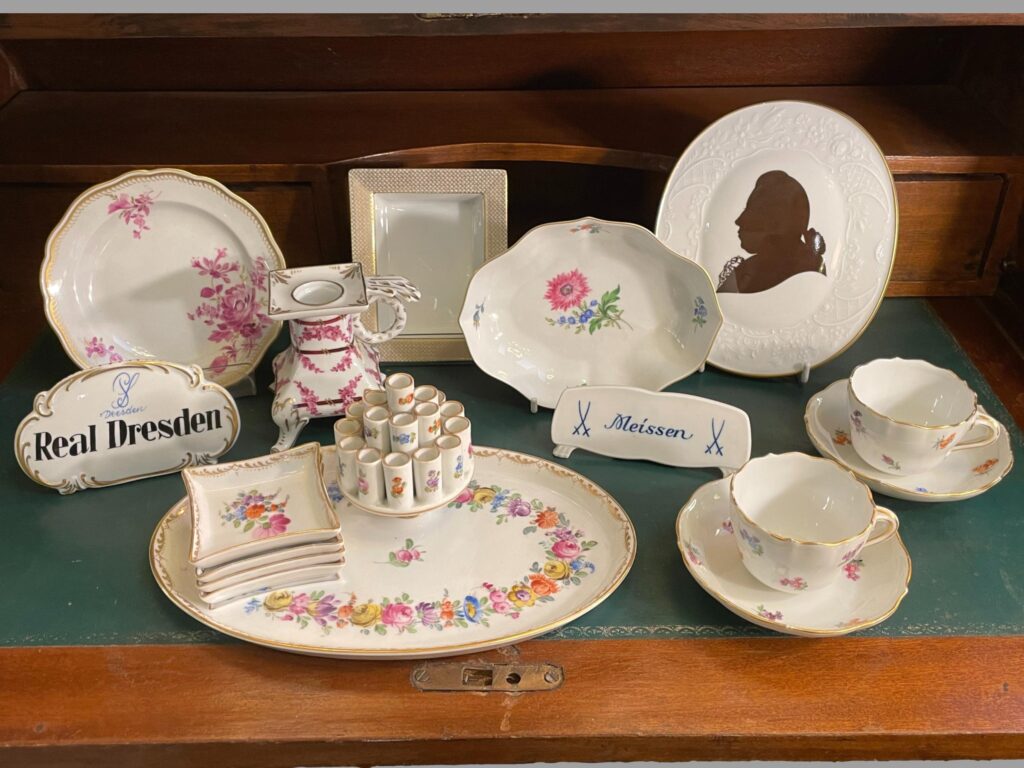
We could spend many hours perusing the exquisite selection of German porcelain produced by the Meissen and Dresden factories.
Highly decorative, perfect examples of plates, tureens, cups and saucers, and candlesticks. This list of beautiful items is vast and extensive. So let’s start with a slice of the history of the Meissen factories.
Meissen, Germany, in 1710 was the first place in Europe to produce hard-paste porcelain. At the request of the ruler Augustus the Strong, an alchemist, Johann Frederick Bottger succeeded after many years in creating European hard-paste porcelain. The secret of the porcelain ingredients was guarded, as it was produced only in the Albrechtsburg Castle.
It wasn’t long before other European nations began producing similar items. So, to identify Meissen pieces from others, in 1722, a cross-sword signature became its trademark.
That cypher remains a good way of identifying genuine pieces today.
The Meissen factory went from strength to strength, producing hand-painted colourful polychrome figurines, including mythical and courtly scenes reflecting the Rococo and Neoclassical style of the era. Dresden’s contribution were the first and most successful to employ the style on dinnerware decorated with fanciful designs using elaborate patterns of foliage, flowers, fruits, shells, and scrolls, and not forgetting the decorative lace that adorned the classic lady figurines. They are perfect collector’s timeless pieces to treasure.
The best collections grow from personal interest.
Many collectors of Meissen begin with a special focus, then they move on to explore other pieces as their interest grows. This creates a collection that is unique to its owner. The provenance of a piece is important to some buyers, but most collectors do not have investment in mind. The value or cost of pieces is secondary to the satisfaction of owning something beautiful.
Antiques of Kingston has a unique collection of Meissen and Dresden perfect porcelain, so come along and view.