
MANS BEST FRIEND
Welcome to the wonderful world of dogs, well, pottery ones in this case! When did we become collectors of dog ornaments? In the early Victorian era, ordinary working folk lived in dark and cluttered dwellings. They sought some colour in their lives that didn’t cost a huge amount of money.
STAFFORDSHIRE POTTERY FACTORIES
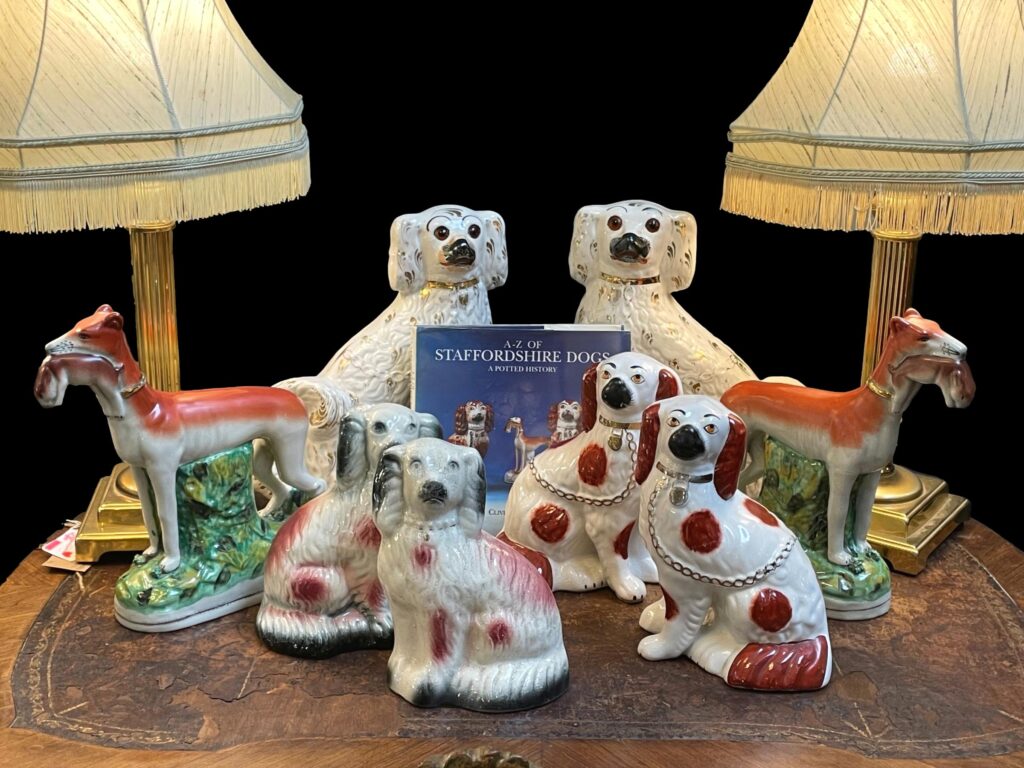
Small factories in the Staffordshire area, employing 10-12 people, began to create simple moulds, producing basic pottery items at a low cost for the masses. Dogs were the favourite choice; they were easy to mould and paint, and everyone had a soft spot for dogs.
The so-called ‘Wally Dogs’ were a popular mantelpiece ornament in a range of sizes, from exceptionally large to tiny. Due to the popularity of the Cavalier King Charles Spaniel, favoured by Queen Victoria, her ‘darling Dash’. Confirmation: Mans best friend.
ARTISTIC LICENSE MANS BEST FRIEND DOOR TO DOOR..
The factories went into production of these attractive and saleable items. People were happy to buy these rather naïve representations of dogs from street market sellers or door-to-door sellers with huge baskets of collectable hounds. The dogs were hand-painted, and no two would look the same, as the expressions were chosen by the artists, who were often young children, giving the dogs a naïve look. The backs of the dogs were white; only the fronts were painted. It was thought they would stand on the fireplace or on a shelf, with their backs not showing.
NOT JUST AN ORNAMENT, MORE A PRIZED POSSESSION.
There is also a cheeky anecdote, stating that a married lady who had a lover set her pottery dogs on the windowsill, facing out, to let the lover know her husband was out! Facing the dogs with their backs to the window meant staying away! Who knows if that were true? It’s probably just old folklore.
MOVING ON WITH EXCITING DOGGY BREED IDEAS.
The factories soon became more adventurous, creating other breeds of dogs, and the next best sellers were greyhounds, expanding the idea that dogs are mans best friend, as the husband of Queen Victoria, known as Prince Albert, owned several of this breed. What the royals had, all classes of people wanted to emulate in some small way. Fun examples, such as Poodles, became extremely popular, featuring curly tactile pieces of pottery applied to the body to resemble fur.
IDENTIFYING GENUINE STAFFORDSHIRE PIECES.
Nowadays, we are lucky to find original Staffordshire pieces dating back to early Victorian times, as they were fragile. Many have survived! When wishing to collect ‘Wally Dogs’, one must check that only one small firing hole is at the base. This is one sign of an antique piece. Also, those early factories did not stamp the pieces with makers’ names or initial them in any way. This is another way of identifying a piece of original Staffordshire pottery.
We have a selection of Staffordshire pieces in our Antiques Centre, so start your collection of these adorable (mans best friend) doggy companions.
Recent Comments